Showing posts with label Shark Bay.. Show all posts

The turtle transcript. Part 2. Scoot'n with ladies.

West point on Dirk Hartog Island
 
We were expertly told by Officer Locke how, where and when to tag the turtles that first night.

First of all we had red light settings on our torches. Loggerhead turtles don’t like the bright, white lights and are likely to try and run??? to the water as quick as they can, which isn’t really that quick at all, if disturbed. 


Shhh
 

Sneaking up to your first turtle from behind, as quiet as the mice of Cape Inscription, donning  a red headlight is exhilarating to say the least. On hands and knees we crawled slowly through the sand and sat down behind the turtle. Steve would give quiet, patient explanations about the egg laying process.


One of the first turtles we spotted.


It is truly amazing what the Loggerhead  turtle does when its on the beach. Caretta Caretta (Latin for Loggerhead turtle) move slowly but powerfully up the beach, leaving a trail behind for the tagger to see. The easiest way to spot a turtle is by looking for tracks. After several days of tagging, we even knew if a turtle had a return track back to the water and not to bother investigating the dune's edge for its whereabouts.

 
Tracks in and out of the beach during daylight


Loggy finds herself a good place to make a pit, slightly bigger than its own body, usually somewhere above the high-tide mark and mainly before the start of the dunes. We call swishing around the sand in that first stage, pitting. Turtles do everything at their own individual pace, but after some time they start building their egg chamber. Amazingly they do this with their hind flippers in a breaststroke, digging kind of action or a wax-on ,wax-off motion. I have seen cavities at least 500mm deep which can take a long time to construct. Then, suddenly, all gets quiet. The turtle has positionsed her body diagonally across the pit with her back end over the chamber. We were told that this is the moment the turtles don't feel a thing due to hormonal painkillers provided by mother nature.

 
A pitt for laying eggs or to stumble in


I had the absolute privilege to see the eggs drop into the chamber close up. It is a beautiful moment which will be imprinted into my semi-grey matter forever. With my little red torch lighting up the scene dimly, I saw the miniature elephant trunk like cloaca (yes, I am hoping you are learning something new here) move forward and then backwards as if contracting. Covered in a slimy substance, round fair -sized eggs dropped down from the cloaca into the chamber.

 
Looking into the chamber underneath the turtle at the eggs by red light


Some turtles are prolific and fill up their chamber to the brim, some just lay a couple and have had enough. Laying procedures come to an abrupt halt when she decides to start covering up the chamber with sand by an almost reverse wax-on, wax-off motion which ends up in a firm flipper full of sand pat-down on top of the eggs. Beach Tai Chi at its best. Throughout the five nights we realize that this is the best moment to tag her while she is still under the influence of natures cocktail of drugs and is worn out from the monumental task that is egg-laying on the beach. 


The multiple use cloaca 


After packing down her eggs with sand, the turtle now reveals her mistress stroke of deception. This is a process called ‘misting’. The only way I can describe it properly, is that it looks like she is trying to swim on dry land. A fine spray of sand is flicked up backwards over the hollow leaving no trace of disturbance. In fact, a fake pit is created right next to the heaped misted sand and therefore tricking every egg predator into searching  the wrong spot. Very clever.  It is not a good idea to sit behind the turtle when it’s misting if you don’t want to be covered in sand. Even more cunning is that the fake pits are left for those unsuspected, tired, turtle taggers to stumble in. This happened time and time again, until we accepted the turtle had ‘one-over’ on us in those long, dark nights and we just kept on stumblin'. I can imagine her smiling each time we went down. After her dry swim, she returned exhausted back to the ocean. She slowed down considerably from the breakneck speed displayed when first entering the beach and takes many a breather on the way out. Sometimes there is a clear passage to the shore and she will disappear in an instant, sometimes she gets stuck behind a rock or on top of a rocky reef. Patiently she will wait to coolly ride the next outgoing wave. The surf will carry her off any obstacle and soon she will disappear in the dark water.


A Ghost crab and egg predator


Grey Bits

Phone (08) 9948 2226 or click on the following links www.sharkbay.org, www.dpaw.wa.gov.au for more information on turtle tagging..


Turtle Bay overlooking beach 3, 4 and 5.


Some nights the tagging was a bit slow due to the turtles numbers being low. If the decision was made to wait for  a turtle to finish laying her eggs, we got comfortable by shoving our back-sides forward and backwards in the sand and laying down in the pit we created. This process we called  “scoot’n”.


Photo taken during an excursion to Dampiers landing


The Turtle Transcript: Part 1, getting to Dirk


Have you ever had the experience where an unexpected adventure smashes your bucket list to pieces? That’s what turtle tagging did for us.


Approaching Dirk Hartog Island


We were gifted this amazing opportunity by the head ranger Chris from Shark Bay to join the turtle tagging team on Dirk Hartog Island (DHI) and accepted the invitation in a hurry.


Firing engines


This time we did not bring any bananas on board (see Banana boat blog) and the engines were roaring as we sailed with the wind through our hair to Dirk Hartog Island. We met the best turtle tagging team in the world on board and high levels of energy were almost touchable in the air. After a rapid off-load of the barge and upload of the Island’s troopy (a Japanese brand troop carrier) we bounced along on white, dirt tracks to Cape Inscription and our new head quarters for the next five days.


Loading troopy


This Island was accidentally bumped into by de Eendracht with Dirk Hartog as captain on 25 October 1616 - the first European to set foot on Australian soil. Apparently the Dutchman misjudged his navigational tools by a couple of degrees on his voyage to the East Indies and, by fluke, landed here. He named the Island after himself, as you would, and put a plaque up on what became aptly known as Cape Inscription. The round plate with inscription of the date and mention of some of the crew, can now be found in the Rijksmuseum in The Netherlands. If you look at the date, it is nearly 400 years ago when the Amsterdammer made his faux pas and a special celebration is planned by the local authorities this October. Twenty six million Aussie dollars is set aside for this purpose, which includes a tour of the replica Duyfken to Denham. I hope you haven’t capsized of boredom with this thrilling history lesson.

 
Historical Cape Inscription


For this semi -Dutch nomad arriving here on this wild barren cape, where currently a crude fake plaque resides over Cape Inscription, has enhanced meaning. Standing there overlooking Turtle Bay, I felt that this is the point where the two countries, that mean so much to me, intersect. Cape Inscription, with its gathering of old and new history, is the place that symbolises my own journey. It is that same melting pot of the quirky twists of fate that enrich my life and in the end has brought me to this Island. 


The road to Cape Inscription


After we settled in at the homestead we were amazed about the co-inhabitants we were sharing the building with. An infestation of cute little grey mice were busily investigating every inch of mostly the kitchen. If you left any food in a bag in your room, holes would appear in your bag overnight and your food would be gone. We all slept under mosquito nets but I saw way more mice than the dreaded mozzies. One girl woke up screaming when a mouse crawled up on the inside of a net and dropped on her head in the middle of the night. Several bungarras lived under and around the homestead and were seen snacking on the rodents.


We enjoyed a team briefing by ranger Steve, the team leader we had affectionately baptised as Officer Locke. This nickname was due to an incident at Francois Peron National Park where we were in hot pursuit of two German tourists that failed to stop for a chat. If you follow that up by riding a quad bike with sunnies and a silver helmet around the island, you are the ‘Po’lice’ in anyone’s eyes.


Officer Locke ready to put on the sunnies


Officer Locke gave us the lowdown on working hours, sleeping times and turtle tagging. Little did we know that other than his huge work ethic, this gentleman also possessed a great sense of humour,   knowledge of the stars, animals, surviving in the wild, bush cooking and porta-loos. We all loved listening to his blue-grass tunes on the guitar to while away the afternoon on the verandah.


Cool breeze and great views on this verandah


We organised ourselves for that night’s turtle tagging training session by packing snacks, checking batteries in our head torches and filling up our water bottles. When we all loaded into the troopy at 1900 we all felt the same thing. A hum of expectation came over us that night. We sat on the two bench seats in the back of the troopy, laughing and carrying on as if we were going to war.


Night Falls....


We are ready to tag some turtle!!!


Cape Inscription light house
 
Grey Bits


Turtle tagging on Dirk Hartog Island is done in January. I hear it is difficult to get in if you are not invited or you don't know someone. Contact DPaW if you are keen to give turtle tagging a shot. Phone (08) 9948 2226 or click on the following links www.sharkbay.org, www.dpaw.wa.gov.au for more information.

If you want to send me an email about anything you have read or have any suggestions for me I would love to hear from you. Click on the link underneath.


Airing the boots out for the nightshift

Walking with sharks: Day 3


This is the story of the semi-grey nomad's attempt to circumnavigate the Peron Peninsular, hiking mainly on the beach from Denham to Monkey Mia. 

Day Three: From Cape Peron to Cattle Well. North to South and thus wind smack-bang in the face all morning.
 
 
Here is that map again. Saves a scroll down


Cape Peron itself is truly spectacular. It is here that I developed a dune fetish. There are several red orangey, rippled sand dunes and not taking photos is almost a crime.


No sooner had  I left my wise friend behind and walked on an old vehicle track when I bumped into three goats ahead on the trail towards the dunes. Two kids following their mum were happily bouncing along in front of me as if they owned the place.  
 

Tails up
 
Along this 10km stretch to Cattle Well there are three places to camp. Bottle Bay, Gregories and South Gregories with toilets and barbecues. These great camp sites have dunnies I've had the pleasure of cleaning a couple of times when assisting Department of Parks and Wildlife staff during a service run. The best time to camp here is around Easter and in the middle months of the year. In December that southerly is too strong for tenting in my opinion.


Before you reach these campsites you have to walk past Sheila's bluff; a stunning half-bowl shaped cliff face with its colours visible from a long way away. 


Bottle Bay was formerly known as Bottle dump because ships came through and dumped their refuge and bottles in this spot. I can assure you that it is a pretty spot and that Bottle Bay is definitely a more suitable name in its current status. It is a white sandy beach with lots of pristine turquoise water and a bit of seaweed of course. One has to be realistic.


Looking North over Bottle beach towards Sheila's bluff.
 
 
During today's walk I expected it to be busy.  There were car trails on the beach and a couple of four- wheel drive access tracks and the snorkelling is great at Gregories. So far, however, on my three days of hiking I haven't come across another soul.

You just cannot miss that special, pungent sulphur odour of Cormorants that are huddled together on the beach or on the rocks. At first I thought I had eaten something that didn't agree with me but then saw the shags. They are a nervous bunch and they either fly off or swim away on approach. I count myself lucky that I do not live in the time of the old Inca Empire of Peru. Disturbing the Cormorants in those days was met with the death penalty as the guano was a precious comodity. Cormorant excrement or guano in Spanish was used to fertilize their crops; it being rich in Potassium and Nitrogen Phosphate. Some organic farmers of today are using guano as an environmentally friendly fertilizer. In this part of the world Dirk Hartog Island was used for harvesting guano some time ago.


I must say that I feel sorry for the poor soul who has to collect the guano. Rocky ledges, high cliffs and looking for smelly ........


Cormorants on mussel covered rocks at South Gregories
 

On today's hike I saw just the one lonely shark in the shallows. So I am gladly notching the one shark under my belt and referring to the title I am still "walking with sharks" even on day three.

Listening carefully to instructions is very important when meeting up with your support crew after a tough day in the boots. Extra kilometres can be had when one enthusiastically makes the decision to change the meeting point without consultation and walk the wrong way in order to mistakenly curtail your support crews waiting time. This is how I ended up walking from South Gregories to Cattle Well twice, adding a highly unwanted 3km to a lovely easy 10km day, earning the scorn of my all-knowing support.

Shouda listened.
 
 
Grey Bits


Looking South towards the first beach from Cape Peron
 
 
I can highly recommend the 1.5 km walk to Skipjack Point and back. If you are going to walk anywhere in the national park this should be the place. There are many helpful interpetative signs on this strech and views are awesome from high above the sea. 


Euro kangaroo prints in the dune

 
Please note, that this hike is through very wild, uninhabited country. In my opinion it is not advisable to attempt this hike without a support team or proper communication devices like a satellite phone or  EPIRB. Hiking experience is a must.

Let the Department of Parks and Wildlife  know where you are going to be and when you plan to return. Phone (08) 9948 2226 or click on the following links www.sharkbay.org, www.dpaw.wa.gov.au for more information.

The best time to walk around the Peron Peninsular is at low tide. You can check the tide levels at www.seabreeze.com.au


Saving a Thorny Devil


Saving a Thorny Devil

What lays beyond the gate of the homestead? Where does that red dusty trail lead to?


The view from the yet to be built look out at Big Lagoon
It was our first Monday at the homestead. All was quiet and peaceful. Our chores had been done, breakfast was had, the kettle had been put on. Ranger Chris had other ideas. He burst around the corner in his Parks and Wildlife ute and in a dusty cloud came to a screeching halt in front of the caravan. He hopped out and asked us if we wanted to join him on a field trip. I stuck my hand up and jumped at the chance. Julie had planned other activities so a boys day out it was. Big Lagoon in Francois Peron National Park was his destination. Ranger Chris lowered his tyre pressure to 16psi – he said that you could even go down as low as 12psi for traversing through heavy sand. As we are driving over that dusty red trail with tyres almost flat, Ranger Chris chatted about “Parks for People", conservation.in general including management of feral animals, regeneration and protection of native flora and fauna.


Closer to Big Lagoon the one lane track started curving sharply left and right giving you that “sitting-duck” experience in regards to oncoming traffic.


After arriving safely Ranger Chris showed me where the new campsite and lookout was going to be built, overlooking Big Lagoon. We walked past some low bushes and Ranger Chris started explaining that this particular bush was Shark Bay Sandalwood or ‘Santalum Spilatum’. He explained that the branches, when cracked, smelled like sandalwood and showed me some of the nuts that were hanging off the branches and some were laying on the ground. He said the nuts, when roasted for ten minutes, tasted like macadamia nuts and were eaten by the Indigenous people of the area.


Sandalwood bush

Later on I found on the Shark Bay website (sharkbay.org.au) that there used to be an industry in Shark Bay making perfume and cosmetics from this bush. Emus are known to eat the rather big nuts whole and then poop them out leaving a more fertilised product behind. It shows how important Emus are in the eco system. Good luck at both ends Mr Emu!!


A Sandalwood nut ready to be swallowed whole by an Emu. Good luck with that!

Ranger Chris showed me many more interesting nature events within a small area – for example there was a hopping mouse trail on the side of the dune and a bush of which the seeds were taken and buried by ants and thus replanted.


At some time during our short drive back from Big Lagoon, Ranger Chris suddenly veered out of the 4wd grooves and stopped. He yelled out to me – "Thorny Devil" and hopped out of the car. I carefully followed him and walked to where a lizard-like creature with grey-yellow spikes and skin armour was sitting in the middle of a tyre track. "Did you get him"? I asked Ranger Chris concerned. "Nah! – he’s alright" was his reply. "Well" said Ranger Chris. "This is your chance to do some conservation of your own". "What do I do"? I asked him. He replied "Just put your hand underneath him, lift him up and place him in the bush away from the road. If we leave him in the tyre track he will just get squashed". "Ok." I said – "let me get my camera first" thinking of Julie and my blog readers in mind.


Picking the little dragon up with my hand was a strange sensation. The Thorny Devil looks so ferocious yet is surprisingly placid and slow. Again later I read that the males bump their heads against each other when the are fighting over a female. Hard to imagine these gentle creatures getting the momentum to kiss each other Liverpool style.


As carefully as I could I scooped a large hand of sand up with the little reptile on top but when the sand had left my hand, like an hour glass, the devil was sitting on my hand, softly prickling my skin with its body armour. I took a real close up look at this prehistoric looking survivor and then placed it carefully in the bush. A burst of happy energy ran through my veins all day from that moment on.


A Thorny Devil making tracks.
Slowly

We could be heroes. A dolphin tail.


We could be heroes.
And now ladies and gentlemen here are your beloved volunteers. Please make way and welcome them to the beach. Put your hands together for Julie and Marcel. And the crowd goes wild.
The Champions walk.
 
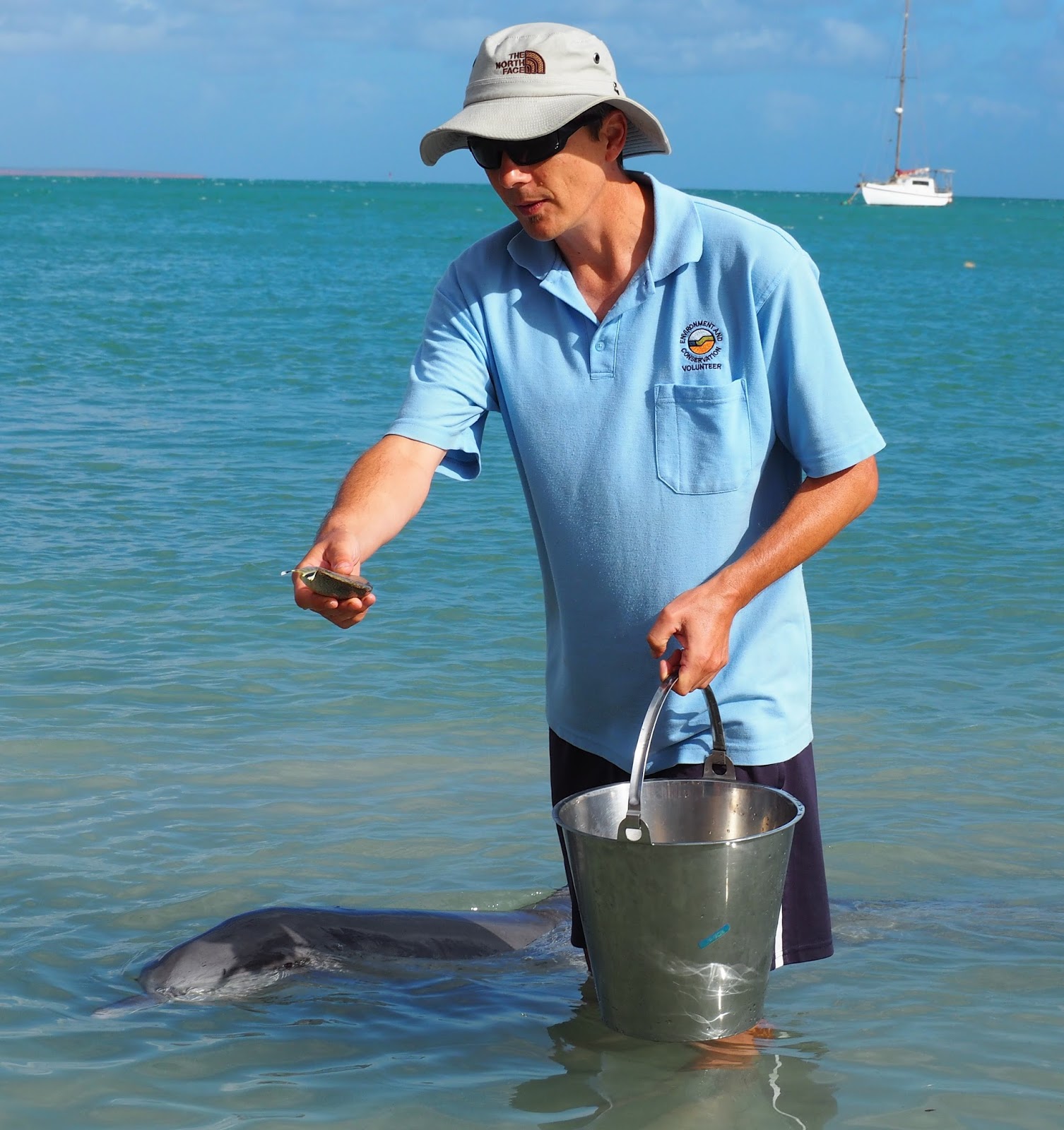
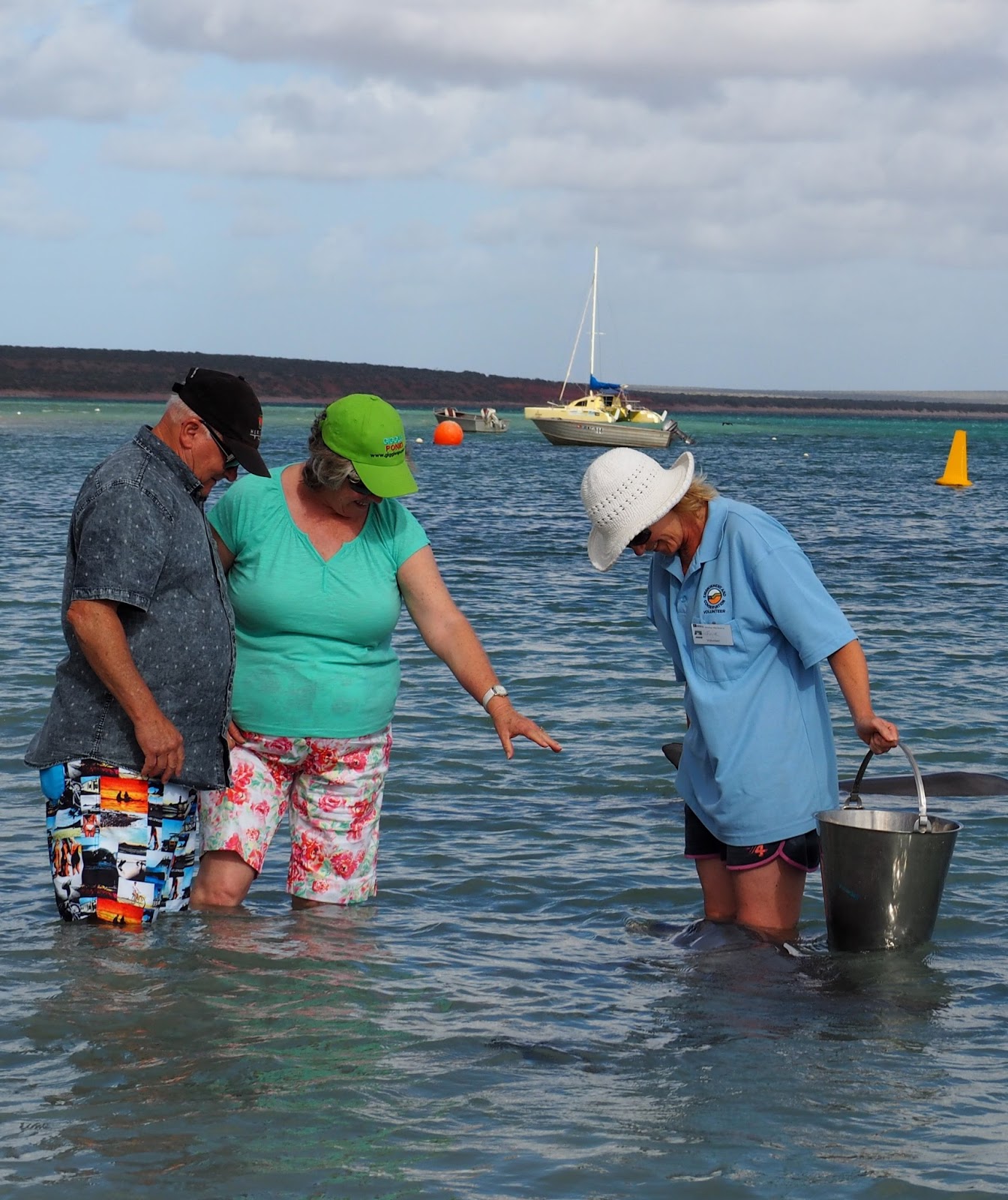
It didn’t really happen like that. However, somehow it felt like we were champions walking into Wembley stadium for an FA cup final. That first ever feed of the dolphins at Monkey Mia. In our hands holding buckets, with two or three fish each, that we defrosted and weighed carefully in the fish room. A crowd of 180 people on the beach with their backs turned to us as they are watching the dolphins in the shallow. We walked across the sand and moved slowly through the crowd to our chosen dolphin. The crowd is prompted to move their feet out of the water back onto the beach while we, the volunteers, get to stand right next to the dolphin in the water.


Shock taking it all in.
The first dolphin I fed was Shock. To greet me she shot a full repertoire of dolphin clicks at me. Shock than rotated diagonally sideways to look straight at me. I was actually a bit shocked with the attention she gave me. She moved right along side of me while I was handing the fish to… sorry, I cant remember who from the crowd. Absolutely mesmerised I went through the process of feeding the other two fish with two more crowd picks. The ranger who was standing next to me at the time later laughed at me and said that I was calling Shock “mate” all the time even though she's a female. I guess I was just waffling nonsense that first time. The final act of the feed is rinsing the empty bucket in the water. Shock and the others cleverly knew immediately that this was the end of   snack time and super gracefully slid away from me. This is the moment I won't forget, as unexpectedly, I choked up and was looking through a haze of tears at the dolphins as they disappeared into Shark Bay. Where did this reaction come from?

Marcel handing a fish to a member of the crowd
with dolphin paying close attention.

Has life as a semi-grey nomad finally been rewarded?

Every time we went into the water to feed these beautiful creatures something amazing happened. Julie received a belly rub from a pregnant Surprise. Surprise was always nudging our legs carefully to hurry up with that fish already.
Julie being touched by a dolphin.
A large pelican named Rogue appeared at times. We always had to cut up a little extra fish for her as she snapped her beak wildly in the air as if imaginary flies were attacking her. We were told she was blind in one eye and needed redirecting away from the buckets of fish at the beach. No other pelican behaved like this. I was lucky enough to have the job of distracting Rogue to keep her away from the fish buckets during the dolphin feeds. I told Rogue in no uncertain terms she should not be a bloody galah and would not get a fish if she didn’t behave. Luckily she did behave. After taming Rogue I was dubbed the "Rogue" whisperer by the rangers who even wrote this on my volunteering certificate.


Jacob aka Michael Keaton counting
the people on the beach.
We met an amazing couple that were volunteering with us. Jacob and Sabina luckily new what the routine was and showed us how to record every gram and dolphin sighting. After feeding time there were many chores to be done without much pressure and plenty of time for tea and free bikkies.
Sabina having fun in the fish room.

The whole scene on the beach is controlled by two rangers. All the rangers at Monkey Mia were friendly and helpful. Best of all they looked like they were enjoying themselves as much as we did.

Finally - let's do some mathematical brain damage here. If there are 180 people on the beach - four dolphins eating 10 fish, what are your chances of being picked to feed and get up close to a dolphin?  Very little you say?

Go volunteer at Monkey Mia. It is a privilege.


Semi-grey nomad tips and links.

  • Feed the dolphins the fish head first. It slides down better.
  • If you'd like to volunteer contact Department of Parks and Wildlife Shark Bay District Ph: (08) 9948 1366 | Fax: (08) 9948 1512 | www.sharkbay.org


  I wish I could swim!
 
Like dolphins!
 
Like dolphins can swim!
 
(David Bowie, Heroes)


Featured post

Do Bikinis and Art Mix?

We made sure we visited one of Australia's most iconic art exhibition in the country, even if we had to fly there from Alice Spri...

Popular Posts