The Chamber of Pillars.


Just 160 kilometres of shake, rattle and dust on a corrugated track separates us from one of the red centres most obscure government run campsites, the Chambers Pillar. We finally ventured out on a weekend when Alice Springs was dancing around a pole in May, in an almost pagan/hippy roman tradition.
Just when you think it is safe enough to crank the car up to a hundred km per hour, a rough dip will play basketball with your off-roader or a bend will slide you through a corner as if Brocky was still alive. After about a hundred kilometres, we stopped to look at the Indigenous art expo at the village of Titjikala, but found that in an act of sheer defiance to the rules of capitalism the exhibition was closed on a public holiday weekend.
Around ten kilometres before arrival, a short but steep drive takes you up a high ridge where the views are 360 degrees and worth stopping for, especially that first glimpse of the Chambers Pillar. Down the hill two gates are to be negotiated by the co-driver. At one of the gates there is a sign advising you to mount your pole with a red flag to the front of your car ‘now’, to warn oncoming traffic that you are rounding the crest.  Yeah!!! Darn!!! Forgot to bring my flagpole. I was tempted to sit on top of the car waving my red undies around, but thought it too dusty up there. Two or three of those apexes were quite hair-raising. For seconds, all you can see is the bonnet creating that out of control feeling. One day someone is going to land their front wheels on someone else's bonnet.


The main event


There is a lot going on at the chamber of pillars.

For sure the highlights are the columns that have stood here as long as anyone can remember. Even though the name Chamber is of a wealthy businessman who sponsored first time explorer John MacDouell Stuart out here; the name itself evokes the feeling of a space with the pillar and surrounding rock features holding up the roof of the world. The colour changes of these rocks at dawn and dusk are truly spectacular, almost emotionally so.

 
This rock formation visible from our campsite - notice nature's window


The Indigenous locals believe that a knob-tailed gecko warrior named Itirkawara rebelled against tribal law by sleeping around with woman forbidden to him. He came to these sand dunes, took a breather, and tragically transformed into a stone pillar. The woman he travelled with turned her head away and became what is now known as Castle Rock. The message is loud and clear for future generations. If you hadn't learned it by now here it is again; don’t mess with the wrong woman.


The knob tailed gecko courtesy of Milan Zygmunt


Castle Rock from this angle looks a lot like a submarine

Some of the oldest graffiti created by the earliest settlers of the red centre is found in relatively sophisticated carvings on the rocks and surrounding the pillar. Willshire and W Bennett (mounted police), Frank Wallis (store keeper of Alice Springs) and William and Mary Hayes who’s family still owns land around here; just to name a few dating back as far as 1884.  Little did our forefathers know that this form of historical acknowledgement of hard sweat and toil, set the precedence for an all-in eyesore of epic proportions. Who would have thought that 'John 1996' thought it necessary to etch his name into history, along with countless others. Never mind that by carving your name into the soft rock, one accelerates the erosion process of this amazing ancient column . The pillar is as the newspaper clipping in the gazebo said  ‘being loved to death’ even at the risk of a $2000 fine.


The John Ross party came through in 1870 whilst scouting the area for the overland telegraph line

There are some great short walks around the rock formations and the climb up the pillar is a must. There is a sunset and sunrise viewing area and wildlife is abundant according to the information on the boards. We spotted a large variety of birds including and a couple of bats. The southern boobook owl, mulga snake and spinifex hopping mouse were a little shy.

The camping is sublime at La Chambre as French friends of ours elegantly called it. Even a long weekend attracted a low number of visitors. The bush campsites were spaced out with fire pits working overtime during the fresh evenings. This is the Northern Territory in full flight - you can pick your favourite star out of a galaxy as clear as picking sultanas out of a cinnamon scroll.


No stars this night but just a spectacular sky
The rocks at the foot of the pillar
Reluctantly, we started our journey home - leaving a beautiful place like this is always hard. We passed through a large barren area where ahead of us a cow tried to outrun our superior human invention. In true bovine fashion it stuck to the road exhausting itself, until she became tired and came to a grinding halt. We parked right next to it and admired the brahman black and white features of the meat production line of Australia, when it unabashedly lifted its tail and just let go of this intense tinkle whilst staring us out.


Two minutes down the road Julie spotted a skinny, lone dingo. The Dingo ran away from us but at a distance ran parallel to the slow driving car as Julie hung out, taking photos of the cantering native.  But wouldn’t you know it?  We found the answer to the Australian version of the question concerning bears, woods and stating the obvious. Does a dingo crap in the desert?


 Picture courtesy of Julie from a moving vehicle
 

 Apparently!


Grey Bits

Check out this fabulous photographer at http://www.milanzygmunt.com/reptiles/nephrurus-levis-knob-tailed-gecko-gekon-knoflikovy/


ANZAC Day. Remembrance in the Red Centre


The horse hides were glistening in the last rays of sunshine. Fine dust kicked up by trampling hooves filtered through the air. Here beautiful!! I said softly. The brumby glided effortlessly towards the fence. Beep-Beep went the camera, now there is an unusual sound for a stockman’s horse. With her head turned, ears pricked up and her eye open wide - staring at me ever so alert. As a city slicker, I have never come in contact with horses that were this energetic and alive.


Notice how she is watching me

Two Indigenous, lean young lads strode over, both wearing wide brimmed cowboy hats. An avalanche of Aranda cut through the air as if a machine gun had gone off. Regretfully, the only thing I could make out were names of places.
 
Dwight, one of the young stockmen at Telegraph Station

"You know what the horses are doing here?" I asked in English. The boys explained in a few sentences, that they had rode the horses all the way from Hermannsburg to Telegraph Station and that they had been in the saddle for 5 days to cover the 130 kilometres.  

After a bit of research, I found out that the senior students of the N’taria school (otherwise known as Hermannsburg) had tamed the wild brumbies themselves over the last 12 months as part of agricultural studies. The students had forged great bonds with, and clearly loved working with the animals. They went on to tell me that the horses were brought down to Alice Springs to ride in the ANZAC Parade. 'This might just be an ANZAC day to remember', I thought.

Every clump of grass looked like a Kangaroo in the high beam as we drove towards Alice Springs in the pitch black, earliest of mornings that ANZAC day. ANZAC Hill towers above Alice Springs and would surely be quite a challenge to make the climb for some. By the looks of it plenty made it as it was shoulder to shoulder, standing room only during the ceremony.
 
Shoulder to shoulder at ANZAC Hill

The Catafalque party left a memorable impression. Hissing commands pierced the night sky. Four guards sprung into action. Watching these skilled soldiers, making their deliberate but deadly quiet strides as they were taking  guard around the monument, as a first-timer was an unforgettable spectacle.
 
Taking guard

We all paid our respects to soldiers never to be forgotten as the sun edged between the horizon and the cloud cover. The lights of Alice twinkling all around and below us. Both Australian and New Zeeland National Anthems were sung - speeches were given by well-spoken dignitaries – a group of policemen and women stood to attention towards my left – wreaths were laid – a child was comforted in her father’s arms towards my right – special mention was made of the Japanese attacks on the Northern Territory - the crowd stood silent - that damn bugle player, he had us all in tears as he played a poignant, almost quivering rendition of the Last Post.
 

"They shall grow not old, as we that are left grow old; 
Age shall not weary them, nor the years condemn. 
At the going down of the sun and in the morning 
We will remember them."
Laurance Binyon

And the crowd repeated in solemn unison:, “We will remember them.”

Later that day, a parade commenced from the council building, where I had plenty of time to take walk up and down the line and get something on film before kick-off. A diverse variety of uniforms and agencies were about to march on a gloomy day back to ANZAC Hill.


Our Aussie soldiers marching on


Alice Springs is a small town, the parade understandably not long, but nevertheless welcomed by an enthusiastic large crowd boosted by grey nomads and tourists.
There was a small contingent of American soldiers in the parade paying their respects, representatives of the central MacDonnell's worse kept and often publicized secret base. 

Schools and community groups were well represented in the ranks, I spotted a father and two kids on a truck, very much advertising that they were from New Zealand. 

This young man looking to follow in his father's footsteps

And there, finally, came the highlight of the parade. The Hermannsburg contingent, all wearing fair dinkum uniforms donated by the Australian Light Horse Association. A vision of historical significance and pride, taking us right back to the Fourth Light Horse Brigade storming the Ottoman trenches at Beersheba. 


To quote a mate from Western Australia who used to live in the red centre, "ANZAC Hill has to be the best place in Australia to hold an ANZAC dawn service."

 Grey Bits

A special mention goes to all the volunteers that worked very hard to make ANZAC day a memorable occasion. The RSL club did some great work providing a free breakfast, coffee and tea (with a dash of whisky - if that tickled your tipple) for a hungry and thirsty crowd.

If you like to read more about the Indigenous students click on the following link:

http://mobile.abc.net.au/news/2015-04-22/aboriginal-students-130km-horse-ride-anzac-wwi-tribute/6413724
The battle of Beersheba is described in detail on this website.

https://www.awm.gov.au/blog/2007/10/30/the-charge-of-the-4th-light-horse-brigade-at-beersheba/

I took way too many photos of the parade. If you like to have a gander just keep on scrolling down.


The police escort with a sound message. Seatbelt, mate!!


The Aussiefixion of Mars 1: A Poppy on a Stick

Like a little seed that slowly sprouted and revealed its first tender strands of pristine white stem only to, unhurriedly, grow the first fresh inevitable tender leaves. The sweet rains empower the growth of the succulent and burly stalk shooting ever so strong roots in attempt to nourish the springing bud that is set to flower…….

Mate! No need to wax lyrical about how you started thinking about Australian citizenship. The idea of becoming naturalized did grow over the years until a poppy on a stick burst the already thinning dam of resistance. This is what I wrote after a memorable afternoon on the Kokoda Track at Brigade Hill. Excuse me for quoting myself.

When it was my turn I walked in deep reflection. The many days on this hike had stripped me bare of all my protective layers - I could almost feel  the forest breathe - my imagination leaped back seventy four years - violent images ran through my mind in this silent jungle. I walked on, out of the jungle and into the sunny,  grass-covered clearing - blue sky overhead. With a sudden jolt, I realized what the neatly placed rows of wooden stakes represented that were stuck into the ground.

The stakes representing the fallen soldiers on top of Brigade Hill
 
 
I briefly managed to hide behind my camera and took many shots using the brown and white (sepia tone) setting - the picture in the view finder aligning itself with my mood. I knelt down to take a close up but that was it. I had no choice other than to let my emotions run free - sadness engulfing me without restraint - this grown man was blubbering his heart out like a baby.
'Torn Apart' written by Marcel Kempe

Call me a softy, but I still feel the affected twinge sometimes, even shed a tear when I read and think about that day in the jungle. With all that raw emotion it simply became clear it was time to attempt to become an Australian citizen. My journey to morph into a fair dinkum Aussie had began.


Walking towards Brigade Hill


What followed was a paperwork battle which took me one year in total. First of all, how do you procure a Dutch birth certificate? ……??? Neither did I. Google rescued my lily-white hiney, not for the first time, and a letter was sent to my place of birth in a small, obscure city in Holland. It was a more than a pleasant surprise when the record of my mother’s sweat and toil arrived after four and a half months – unannounced -  without acknowledgement of any sort  – no check if I was really me. 

I must stress that filling out forms is not my strong suit and by the time I had completed, signed, sent off for verification, sent some more forms for verification as I had missed a couple of pages, paid all hefty but well worth the money associated bills, photocopied through a pack of laser paper and half checked a mistake-riddled, thumbed-through manuscript, I was happy to send this naughty baby back to its parents. The Australian Department of Immigration.

I had resigned myself for another long wait when only two weeks later emails from the Strayan government started tying up the loose ends and inviting me to sit a test. It was at that moment that I realised something I worked hard for, but always felt depressing, paralyzing doubts whether it would ever happen. The release came in the form of excitement, disbelieve and more excitement. In two and a half hours I cannoned through the accompanied information and,  immediately after, took 10 minutes to mock test myself.

Okay. Honesty required here, nineteen out of twenty is not bad, right? The question I got wrong pertained to the Australian Senate and how it works. Yeah, what are they actually doing there?  I asked that same question that evening at a spontaneous coffee catch-up meeting with a cluster of Dinky Dye Aussie’s (Australian Citizens that is) and none of them knew the answer either. In fact, I found out that most would have failed the mock test much to the overall hilarity of the surrounding true blues.

 
Again, in a surprisingly fast time, I was booked in to sit the real, official test. I remember being slightly disappointed that the test venue was in the same building as Medicare and Centrelink. Where did I want it to be? On top of Uluru?
 
Ok, I just wanted to show off this photo

The lady behind the desk revealed that she loved this part of the job as only happy people came through her door on citizenship test day. So was I. Given three quarters and with plenty of cheery adrenaline feeding the brain cells, I scored a bragging-right earning twenty out of twenty after only 10 minutes. The lady was happy enough to announce that I passed.

As I floated through the dole office, leaping cartwheels in my mind, the thought came to me that this was the best place in Australia to sit a citizenship test. Isn’t it in this office that gallant Australians look after their own and take it up for the sick and temporarily unemployed? What’s more, isn’t Alice Springs the red heart of Australia? A wonderful, multicultural melting pot where kangaroo tails are a delicacy, the land is stained with colonial sweat and blood and is of a beauty rich and rare. Please nail me to this cross, anytime!
 
Of beauty rich and rare!
 
Australians believe in peace, respect, freedom and equality. An important part of being Australian is respecting other people’s differences and choices, even if you don’t agree with those choices. It is about treating people fairly and giving all Australians equal opportunities and freedoms, no matter where they come from, what their traditions are, or whether they are male or female.
A quote from "Our Common Bond". Citizenship application booklet 

I hopped in my car and drove through the Gap to my desert home feeling a hundred percent Australian.

Mate!!

To be continued......
 
 Grey Bits


Thanks to Mel for verifying my paperwork.

Thanks to the Australian Government for their fast and efficient work.

Thanks to you all for allowing me to share this wonderful country with you.

Massacre at Tnornala - How a Baby Dropped to the Earth


Imagine an object flying through space faster than anything you have ever seen. Imagine it is faster than a formula one racing car and, yes, to use a well used frase in marvel land, faster than a speeding bullet. At 72,000km per hour the icy mass, also known as a comet, travels a cool 20km per second in distance, leaving a bullet to believe it is has turned into a snail. Six hundred square metres of swashbuckeling ice-cone lining up our earth thinking “I just cant miss that fat lot down there”.
 
Now visualize a flat piece of untouched Australian outback such as the area 170km west of Alice Springs. A peaceful place - birds singing – lizards hiding under the spinifex – kangaroos lazing around, resting on their elbows - a soft breeze gently blowing through the occasional Wattle Tree. And......

 
A model of Tnorala (Gosses Bluff) displayed at the Araluen Cultural Centre

The impact must have been stupendous and the sound eardrum-destroying. Nature's alien power squashing the earth beneath, forcing its crust up and out in a jaggered mountainous circle with debris flying in all directions.
 
 Where was Superman?
 
A sample of the cone shaped fragments with horsetail markings that
 were flying through the air at the moment of impact.
Displayed at the Araluen Cultural Centre

  
Ever since that moment 142.5 million years ago Tnorala, as its known by the indigenous locals, became a place of cultural significance. Dreamtime tales of long ago passed down from elder to child for many thousands of years, will tell you a story about Tnorala and how it originated.

Tnorala was formed in the creation time, when a group of women danced across the sky at the Milky Way. During this dance, a mother put her baby aside, resting in its wooden baby-carrier (a turna). The carrier toppled over the edge of the dancing area and crashed to earth where it was transformed into the circular rock walls of Tnorala.
Information from the government website.
 
A baby falling from the sky. Photo courtesy of Pintrest

Again my imagination goes rampant.  I envisage the party that must have lit up the sky like a gigantic Saturday night disco, beaming light into the infinite space like shooting stars bouncing off a mirror ball - woman boogieing the night away, letting their hair down and forgetting the menial tasks of life – the whoopsy moment, where the huge baby drops from the sky unnoticed, gouging a massive hole in the surface of the earth. Maybe there was even a bit of a tiff between these ancient giants as to whose responsibility it was to look after the 600 square metre sized infant. A charming story.

More historical facts about the large dent in the earth becomes evident as you drive into another world through a wall of the rough circular range. The millions of years having done us a favour by carving a creek through the large crater walls. Driving over the red dirt, or is it a creek bed, you suddenly, in a large exhale of breath, find yourself in the centre of impact zone. The road ends at the picnic area where you can read the story told by Mavis Malbunka an aboriginal elder.


Mavis Malbunka at Tnorala. Photo courtesy of the ABC
 
“One day, early in the morning, a man climbed up the rocks, hunting for kangaroo. When he came back he found all his people, men, woman and children dead, killed. He knew that kadeaitcha men had done it”.

“The man went off and told all the rest of the family, who lived all along the nearby ranges. These people followed those Kadaitcha men, who came back from desert country, to the south of here. The kadaitcha didn’t make it back to their community. They were killed by the avenging family”.

Quote from information panel at Tnorala.

When you are sitting having your sandwiches at the declared ‘sorry sight’ let the violent, haunted history permeate through your soul, respect that you are asked to camp outside the crater and enjoy the rugged beauty that is Tnorala.
 
When he came back he found all his people,
men, woman and children dead, killed.
 
 Grey Bits

I googled Mavis Malbunka out of curiosity and found that she features on the honour role of the Australian of the Year Award. There is a great article written in the age about the stolen generation including excerpts of an interview with Mavis.
Gosses Bluff when I first spotted it from the Larapinta trail

For more general information about the area, please head to the  government website


Inside the crater walls
 

The Sheffield Shield comes to Mparntwe


Cricket can be a tremendously exciting game. Smash a tonne for your club or country for example or take a rip-snorting catch while suspended in a mid-air - arm outstretched or belt a four to win off the last ball in front of a packed stadium. Not a great comparison to the 2016 – 2017 Sheffield Shield final that surprisingly was held at Traeger Park in Alice Springs (Mparntwe in the local Indigenous language). The Victorians had long ago crushed the South Australians by batting them into submission. Eight hundred runs, a mighty task to achieve, within a five day time frame. The last day, as far as the game goes, was for the pure cricket tragics or diehard Victorian supporters who may have experienced some ever increasing sense of euphoria as their team came closer to a winning draw.


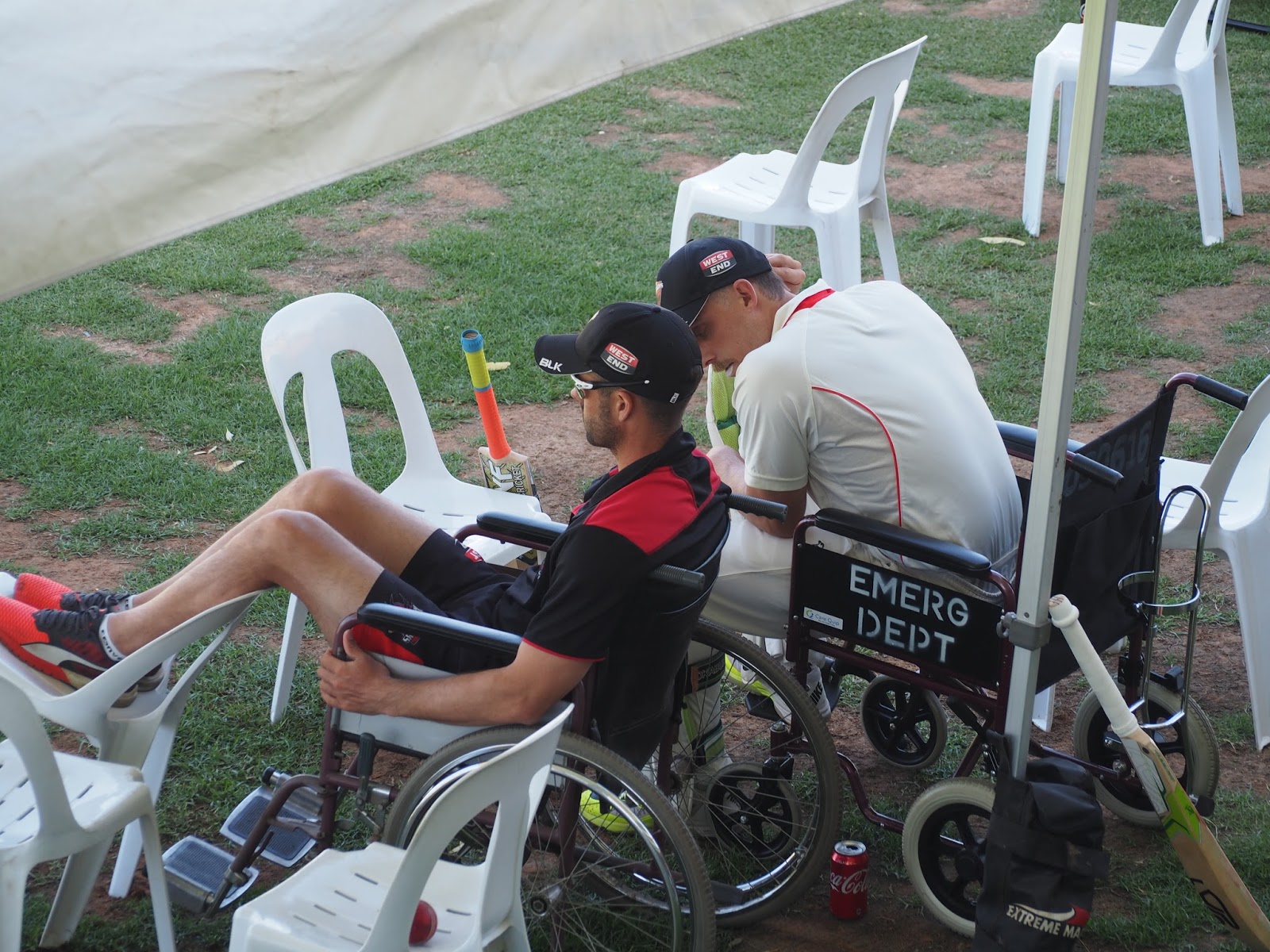
The South Australian players were not doing too well


Cricket can be a lonely game

 
After four days of hard toil in more than 37 degree heat day five was the launch of the cooler autumn weather in the centre of Australia. A breezy 27, cold for recently summer-baked Territorians. The lush green oval that is nestled between the Todd River and the Central MacDonnell Ranges – a stone throw away from the gap - is a beautiful spot to bring a classy game of cricket. The combination is truly a cracking sight.


With approximately 50 others spectators, I watched a despondent captain Travis Head knock the ball around with ease all day long.  He greeted his tonne with almost disdain, barely raising his bat to acknowledge a subdued applause from the meagre crowd. The opening photo of this blog is taken of Travis Head scoring a single to reach his 100, almost cleaning up short leg in the process.
 
A light wave of the bat

There is something about elite sportsman in full flight. Fast bowling was on display at its best with Patto (James Pattinson) steaming in and ripping the ball across the pitch - it was hard to pick up the cherry from side on. Fawad Achmed’s spin bowling had the South Australians in all sorts of trouble and was a pleasure to watch. The Pakistani born leg spinner had the tormented  batsman surrounded by fieldsmen as he took 3 for 81 in the Bushrangers push for victory.


Patto steaming in

A lone spectator chilling out in the private box

With Travis Head unbeaten on 137 and the match going nowhere at 6 for 236 the South Australians declared the match as a draw, half an hour before the end of play. Unable to reach the huge target, the draw meant that Victoria won the Sheffield Shield for the third year in a row. A great accomplishment in a tough competition.


Celebrations started immediately with the Victorians slapping each other on the back, shaking hands and bear-hugging all in sight. The Melbournian victory song reverberated out of the change rooms and across the ranges.
 
The Bushrangers walking off the field victorious
You have to feel sorry for the captains who are required to make a speech after every competition and front the media, win or lose. It appears that sports people are no longer allowed to express themselves in the fear of causing a stir in the media. Every speech now is a repeat of the last one. Front up, acknowledge sponsors, opposition, support staff, teammates, crowd (if you’re lucky) and step away as quickly from that microphone as if it were a hand grenade without a pin.  It always baffles me that people still applaud for these pre-programmed clichés.


The classic Sheffield Shield, a donation to the
NSW Cricket Club by the Earl of Sheffield


The shield is no longer lifted in the air as they do in other sporting codes due to its sheer weight and occupational health and safety risks.  The victorious Victorians gathered joyfully around their Sheffield Shield. They will spend the weekend in the magical dead heart, rejoicing the spoils of  battle while the ancient Northern Territorian natural walls of grandeur as ever remain silent.


Winners once again

 
Grey Bits

I found the following article an interesting read
 
The Aussie, Northern Territorian , Indigenous and Torres Straight Islander flags flying high in a stern desert breeze

Find the complete score card on the following link:
http://live.cricket.com.au/#/1884/40673/overview

This one's for you Peter!

Featured post

Do Bikinis and Art Mix?

We made sure we visited one of Australia's most iconic art exhibition in the country, even if we had to fly there from Alice Spri...

Popular Posts